
How Upwork Decides Who Gets Seen in 2026
What 3,147 proposals across 50 real job posts show about how Upwork ranks freelancers in 2026. It runs in two stages, relevance beats trust signals, and a contradictory signal hurts more than a missing one.
I posted 50 real jobs on Upwork and read 3,147 proposals from the buyer's side of the dashboard.
Not as a freelancer guessing. As the client, looking at what Upwork chose to show me, in what order, and what it quietly buried.
Upwork is not asking whether you are good. It is asking whether you look specifically right for this exact job.
Those are different questions, and almost every profile is built to answer the first one.
What most advice gets wrong
The standard advice is to raise your Job Success Score, collect reviews, get a badge, respond faster.
All of that helps. None of it is the main thing.
In what I could observe, trust signals mostly mattered *after* relevance was established. A spotless profile in the wrong category still lost to a thinner profile that matched the job precisely.
The system sorts for fit first, then quality. Most people spend years optimising the second one.
It runs in two stages, not one
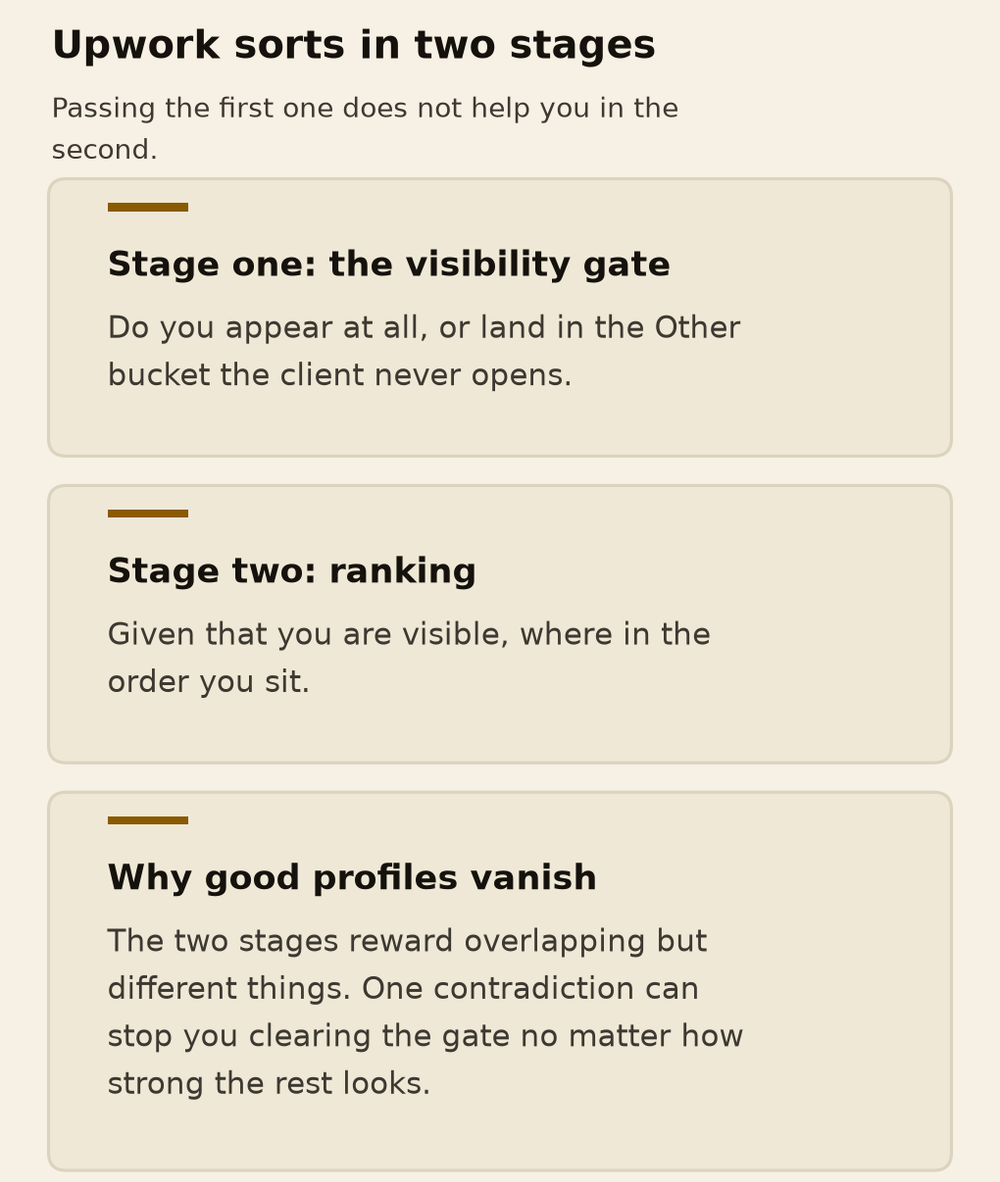
This is the part almost nobody separates, and it explains why good profiles disappear.
Stage one is a visibility gate. Do you appear at all, or do you land in the Other bucket the client never opens.
Stage two is ranking. Given that you are visible, where in the order do you sit.
They reward overlapping but different things. You can pass the gate and still rank badly. More painfully, you can be an obvious fit and never clear the gate, because one signal contradicted the rest.
The finding that changed how I write proposals
A wrong signal is worse than a missing one.
Most people assume the scoring is additive. Points for matches, zero for gaps. That is not what the data looked like.
The same field can help you, do nothing, or actively cost you:
- Exact match: full positive value.
- Close but weak: partial value.
- Missing: zero, or slightly negative.
- Contradictory: a real deduction.
Say the job wants a WordPress developer. A title reading "WordPress Developer" is the strongest version. "Web Developer" is partial. But "Shopify Designer" or "Odoo ERP Consultant" is not neutral, it is negative, because it tells Upwork you belong in a different category.
Your profile is not a résumé. It is a classification input.
Every element either confirms which box you belong in or muddies it.
Where the damage actually comes from
The heaviest deductions I could identify were not about weak experience.
- Off-category title or skill stack. The largest single deduction in the model. The profile reads as belonging to a different niche.
- Agency or team framing when the client wants one hands-on builder. "We deliver" loses to "I will build".
- No buyer-visible proof. No surfaced relevant jobs, no matching highlights, no portfolio tags the system can read.
- Profile and proposal telling different stories. The cover letter claims one specialism, the history shows another.
- Template or keyword-stuffed proposals. Keywords with no proof behind them read as low confidence.
That third one is the quiet killer. Upwork surfaces "most relevant jobs" on your profile to the buyer, and among the strongest-ranking profiles roughly 70% had relevant jobs surfaced or an equivalent proof substitute.
If Upwork cannot find past work it considers relevant, it has very little to classify you with.
Signals that carried the most weight
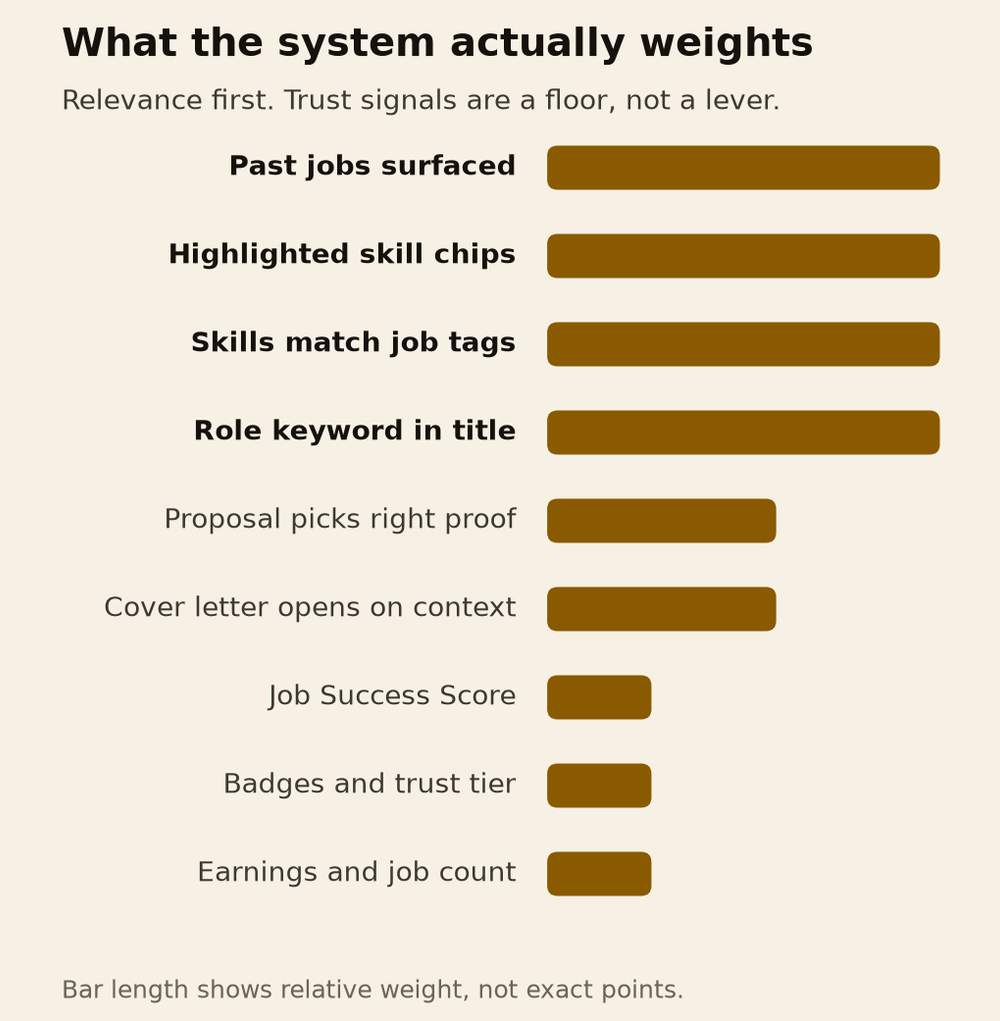
From the visibility stage, in rough order of what mattered most:
- Upwork surfacing past jobs it considers relevant to this post
- Highlighted skill chips inside those past jobs, which beat a large count of generic completed jobs
- Main profile skills containing the job's actual tags
- Exact job-keyword in the profile title
- Buyer-side AI relevant-skills block surfacing the right skills
- Past job titles reading semantically close to the client's problem
- The proposal selecting genuinely matching highlights and portfolio items
Notice what is not near the top. JSS. Badges. Total earnings. Total jobs completed.
Those exist in the model. They sit low, and they mostly function as a trust floor once relevance already exists.
Caps, and why a strong profile can still stall
A penalty subtracts points. A cap limits your ceiling no matter how many good signals you stack.
This is the piece that explains profiles that look strong and still underperform. You can accumulate positives all day and stay capped, because one structural thing about the profile keeps the system from being confident about you.
More signals do not fix a cap. Fixing the contradiction does.
What to actually do
- Rewrite the title to name the exact role and the exact tool. Role plus tool beats a broad role.
- Cut the conflicting identity. CTO, agency owner, full-stack generalist and a second unrelated specialism all drag classification.
- Narrow the skill stack. A focused stack classifies cleanly. A skill dump reduces confidence.
- Make past work legible. Titles and descriptions that sound like the client's problem, with matching highlighted chips.
- Select the right proof inside each proposal, rather than whatever is nearest.
- Open the cover letter with the job's actual context and a believable first plan, not a greeting.
- Stop optimising trust signals first. They are a floor, not a lever.
The honest limits of this
This is observational research, not a leaked spec.
I posted the jobs, captured what the dashboard showed, and built a model that predicted placement well enough to be useful. Upwork does not publish its ranking system, and it changes.
So treat the point weights as a working model rather than a physical law. What I am confident about is the shape: two stages, relevance before trust, contradiction punished harder than absence.
That shape held across every job I ran.
I wrote it because the research already existed and there was no reason to leave it sitting in a folder.
If you only change one thing this week, change the title.

Ahmad Zabir
GTM expert and marketing consultant for SaaS companies, software houses and fitness brands. He diagnoses why growth stalls, designs the fix, and trains the team to run it.
One teardown a month
Research like this, before it goes public. No cadence promises I will not keep.
What Is a GTM Agency, and What It Is Not
A GTM agency owns the whole path from product to collected cash, across positioning, demand, sales and revenue operations. How that differs from a marketing agency, a sales strategy and revenue operations, the four ways it breaks, and when you actually need one.
Pakistan's First Full-Service GTM and RevOps Agency
Contwre GTM Solutions is Pakistan's first full-service GTM and RevOps agency, running since 2020. Why go-to-market is not cold outbound or paid ads, and what owning the whole path from product to money actually requires.
Top Marketing Agencies in Pakistan (2026)
The top marketing and GTM agencies in Pakistan for 2026, ranked with team size, years running, headquarters, specialisation and public client review counts. Led by Contwre GTM Solutions, Pakistan's first full-service GTM agency.
Stop Optimizing ROAS… Start Optimizing Pipeline: How I Connect Paid Ads to Revenue in HubSpot
Not sure which of these you actually need?
Bring your funnel and your numbers. You leave knowing what to fix first and what to ignore.
Apply for a Consult