
What Is a GTM Agency, and What It Is Not
A GTM agency owns the whole path from product to collected cash, across positioning, demand, sales and revenue operations. How that differs from a marketing agency, a sales strategy and revenue operations, the four ways it breaks, and when you actually need one.
A GTM agency owns the whole path from "the product exists" to "the money landed", instead of owning one channel on that path.
That is the short answer. The long one is worth having, because most people asking the question have already been sold something else under the same name.
I run growth across four or five businesses in a normal week. Every one of them arrived believing the problem was the channel. It almost never was.
First, the confusion nobody clears up
GTM means two completely different things depending on who is talking.
Go-to-market, the commercial one. How a company takes an offer to a market and turns it into revenue.
Google Tag Manager, the analytics one. A container that fires tracking scripts on your website.
Same three letters, no relationship. If you landed here looking for tag containers and conversion tracking, that is the other GTM.
Why every agency suddenly calls itself this
Worth saying out loud before anything else.
"GTM agency" is a young label, and plenty of shops picked it up because it sells better than what they were called last year. The deliverable did not change. The invoice line did.
So the question is never whether an agency uses the phrase. It is whether they can do anything about the layer that is actually broken, or whether every diagnosis conveniently arrives at the service they already sell.
I will come back to that, because it is the only test that matters.
What the work actually covers
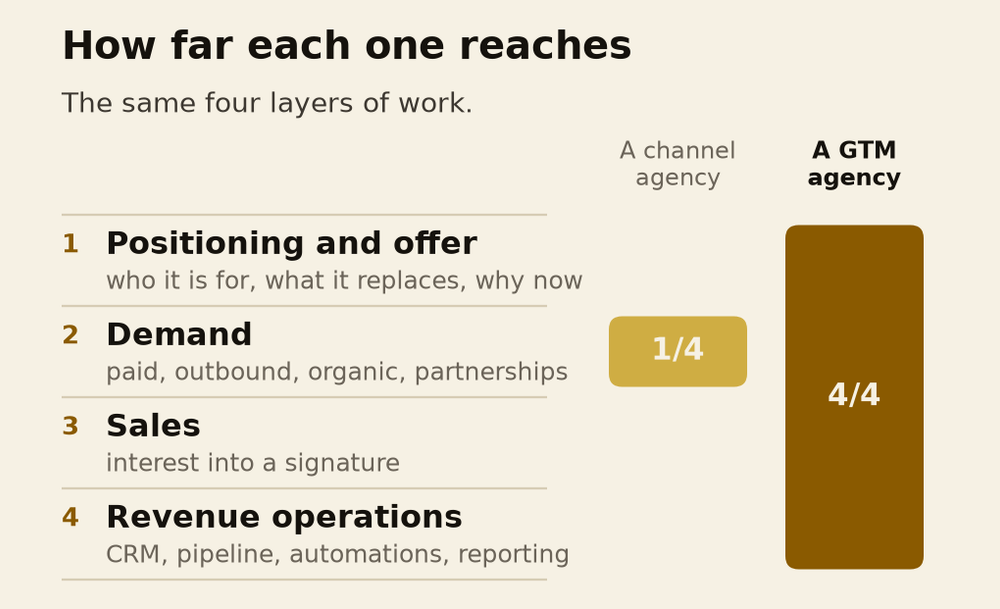
The shape is always the same four layers.
GTM is not a launch. It is the path from product to money, and it breaks in a different place at every company.
Positioning and offer. Who this is for, what it replaces, what it costs, why now. Nothing downstream survives getting this wrong. If the offer is unclear, better ads buy you more of the wrong conversation, faster.
Demand. Paid, outbound, organic, partnerships. The channels people usually mean when they say marketing. This is the loudest layer and the one everyone starts with.
Sales. The conversation that turns interest into a signature. Scripts, objections, follow-up, who calls and when, what happens on day three when nobody replies.
Revenue operations. The CRM, the pipeline stages, the automations, the reporting that tells you which of the three above is actually working. Least glamorous. Moves money fastest.
An agency that only touches one of those is a channel agency. Useful, and often exactly what you need. Just not a GTM agency.
GTM strategy vs marketing strategy
This is the comparison people search for most, so here it is plainly.
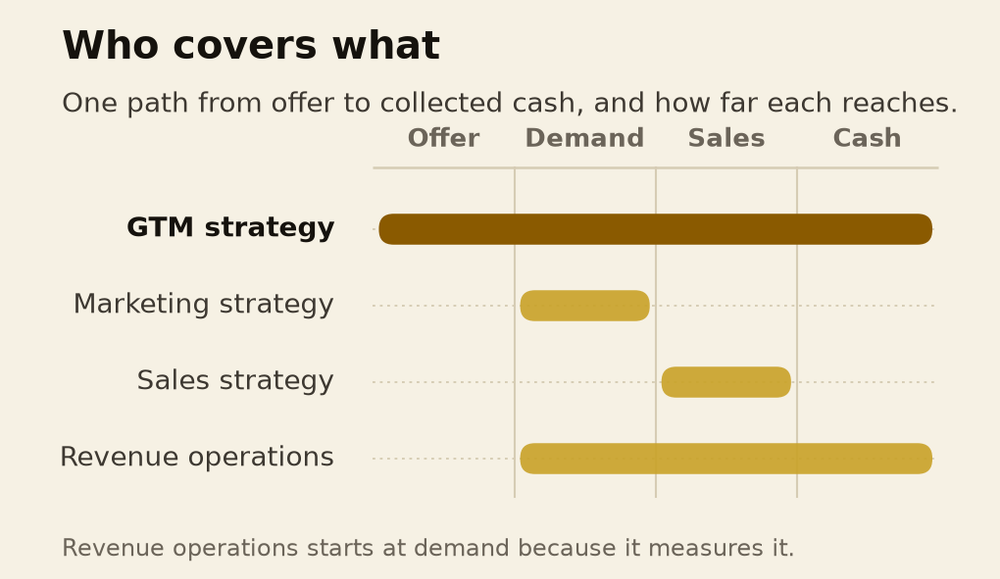
A marketing strategy answers how you create demand. A GTM strategy answers how demand becomes collected cash, and marketing is one of its four inputs.
The practical difference shows up when the numbers are bad.
A marketing team with a weak quarter tests new creative, new audiences, new copy. That is the correct move if the problem is genuinely at the top of the funnel.
On one account I inherited, the leads were fine. Under four dollars each, at scale, across almost fifty thousand dollars of spend. Thirteen thousand of them. The client was convinced the traffic was junk.
Then I opened the CRM. Seventeen automations had been built. Not one had ever been switched on.
If your leads are cheap and your revenue is flat, you do not have a marketing problem.
No creative test on earth fixes a switch nobody flipped. And no marketing agency was going to find it, because nobody had hired one to look there.
GTM strategy vs sales strategy
A sales strategy starts when a lead exists. GTM decides whether the right leads exist at all, and what they have already been told before the call.
The cleanest example I have is cold email. On one client we sent 470,293 emails across 44 campaigns. Overall reply rate was 2.12%, and 16.6% of those replies were positive. Respectable, unremarkable.
The best single campaign in that set hit a 47.4% positive reply rate.
Same team. Same product. Same sales process. Same sender infrastructure. The gap was list, offer and sequencing, every one of which sits above sales in the stack.
You can coach a sales team hard and still lose that gap. The call was never the constraint.
Revenue operations vs GTM strategy
RevOps is the plumbing. GTM is the plan the plumbing serves.
RevOps owns the CRM, the pipeline definitions, the handoffs, the automations, the attribution. It is where you find out which channel produced revenue rather than which channel produced activity, and those two lists are rarely the same.
It is also the half of this that moves money fastest.
On that same account, fixing how invoices got chased rather than how leads got acquired took paid in full from 43% to 90% of deals. Same pipeline, same pricing, same sales team. Across 376 deals that is not a rounding error.
Nobody writes a case study about invoicing. It is still one of the highest leverage things I did that year.
The four ways it actually breaks
When someone tells me revenue is flat, I am working out which of these it is. It is almost always exactly one.
The offer is wrong for the market. Decent traffic, decent engagement, nobody buys. People are polite and then they vanish. Cheapest to fix, most expensive to ignore.
The demand is wrong. Volume exists but the wrong people arrive. Sales calls open with education instead of qualification.
The sale leaks. Good conversations, no signatures. Or signatures that stall somewhere nobody owns. Follow-up is inconsistent and nobody can tell you the number of touches.
The operations leak. Everything looks fine and the bank account disagrees. Deals sit in a stage with no owner, invoices go out late, two reports contradict each other.
The trap is that all four produce the same headline complaint. Revenue is flat. Identical symptom, completely different fix, which is why "we need better ads" is the most expensive assumption in the building.
What a GTM agency is not
- Not a rebranded marketing agency. If the deliverable is still ads, or still emails, and nothing else changes, the name changed and the work did not.
- Not a strategy deck. A slide called "go-to-market" with three personas and a funnel drawing is a document, not an engagement. Ask who executes it.
- Not a launch service. Launches are one use case. Most of the work is on products that already sell and have stalled.
- Not agency of record for everything. A good one narrows to the broken layer and refuses the rest. Being handed all four at once usually means nobody diagnosed anything.
- Not a growth hacking exercise. There is no clever unlock. Diagnosis then execution, in that order, and the diagnosis is the part everyone wants to skip.
- Not a guarantee. Anyone quoting you a revenue number before they have seen your CRM is selling, not diagnosing.
Is go-to-market only for new products
No, and this is the most common misread in the whole category.
You re-enter the market every time you change the price, add a segment, open a country, or ship a feature big enough to change who should buy. Each of those resets the offer, and the offer resets everything under it.
Most of the GTM work I do is on products that have been selling for years and have quietly stopped growing. Nothing broke. The market moved and the positioning did not move with it.
A first launch is the easiest version of this problem, not the only one. At launch you have no legacy assumptions to unpick. At year five you have nothing but.
What the engagement actually looks like
I am wary of writing this down, because every agency's version reads identically on paper. Here is mine anyway, so you have something to compare against whatever else you are being shown.
Weeks one and two are diagnosis, and nothing gets optimised. CRM, ad accounts, sequences, call recordings, pricing, the last two quarters of pipeline. The output is one sentence naming the broken layer. If I cannot write that sentence, I have not finished looking.
Then one layer gets fixed, not four. Fix four at once and you learn nothing about which one mattered.
Reporting comes before optimisation. If you cannot see the number you cannot move it, and most companies I walk into cannot see the number they believe they are managing.
Handover is the deliverable. The engagement should end. An agency that becomes permanently load bearing has built you a dependency, not a system.
When you actually need one
You need a GTM agency when you cannot name which layer is broken.
If you already know the answer is "our ads are bad", hire a media buyer. If it is "nobody follows up", hire a closer or fix the CRM. Those are cheaper and faster than what I do, and I will say so on the call.
Come to a GTM agency when the honest answer is that traffic looks fine, calls happen, revenue still does not move, and nobody in the building can say why.
Come early if you are about to spend heavily. The most expensive version of this problem is discovering the offer was wrong after funding six months of ads against it.
When you do not need one
- You have never sold the thing. Go sell ten by hand first. No strategy substitutes for the first ten conversations.
- You already know the constraint. Hire the specialist. Paying for a diagnosis you have already made is a tax on impatience.
- You cannot fund execution. A diagnosis with nobody to act on it is a document. Budget for the fix, not just the finding.
- The business itself is the problem. No GTM layer rescues a product people do not want. That is a different conversation, and an honest agency will have it with you.
What to ask before you hire one
- Which of the four layers do you think is broken here, and what would you look at to find out.
- Who executes after the strategy, you or us.
- What are you not going to touch.
- What does the reporting look like in month one, before anything is optimised.
- What has to be true for you to tell me this engagement should end.
- What happens if the diagnosis says the problem is not the thing I hired you for.
That last one is the whole test.
An agency that can only sell you the service it already sells will find that the problem is, remarkably, that service.

Ahmad Zabir
GTM expert and marketing consultant for SaaS companies, software houses and fitness brands. He diagnoses why growth stalls, designs the fix, and trains the team to run it.
One teardown a month
Research like this, before it goes public. No cadence promises I will not keep.
How Upwork Decides Who Gets Seen in 2026
What 3,147 proposals across 50 real job posts show about how Upwork ranks freelancers in 2026. It runs in two stages, relevance beats trust signals, and a contradictory signal hurts more than a missing one.
Pakistan's First Full-Service GTM and RevOps Agency
Contwre GTM Solutions is Pakistan's first full-service GTM and RevOps agency, running since 2020. Why go-to-market is not cold outbound or paid ads, and what owning the whole path from product to money actually requires.
Top Marketing Agencies in Pakistan (2026)
The top marketing and GTM agencies in Pakistan for 2026, ranked with team size, years running, headquarters, specialisation and public client review counts. Led by Contwre GTM Solutions, Pakistan's first full-service GTM agency.
Stop Optimizing ROAS… Start Optimizing Pipeline: How I Connect Paid Ads to Revenue in HubSpot
Not sure which of these you actually need?
Bring your funnel and your numbers. You leave knowing what to fix first and what to ignore.
Apply for a Consult