
Cold Email vs LinkedIn: What the Numbers Actually Say
Most comparisons divide LinkedIn replies by accepted connections and email replies by emails sent, which rigs the result. Corrected per prospect, the gap is under two times, and the same audience data says the channels reach different people.
Almost every comparison you will read puts a cold email reply rate next to a LinkedIn reply rate and declares a winner.
Those two numbers are not measuring the same thing. They usually are not even dividing by the same kind of object. Once you line the denominators up, most of the gap disappears, and what is left is a far more interesting finding.
The comparison everyone makes is broken
Here is the trap, using one agency's published figures.
Belkins reports a cold email reply rate of 0.45%, measured as replies divided by emails sent, with auto-replies excluded.
The same company reports LinkedIn replies at 8.18%.
Fifteen times better. Case closed, move the budget.
Except the LinkedIn figure is replies among people who already accepted the connection request. It excludes everyone who ignored you. The email figure includes everyone you mailed.
Do the arithmetic properly. Acceptance was 25.31%, and 8.18% of those accepted replied. So out of 1,000 connection requests sent, about 253 accept and about 21 reply.
LinkedIn: about 2.07% of connection requests sent end in a reply.
Now do the same correction to the email side, because this is where I nearly made the error I am complaining about.
That 0.45% is per email sent, and a sequence sends one prospect several emails. A three-step sequence to 1,000 prospects is 3,000 emails. So per prospect, email reaches at most about 1.35%, and the true figure is lower, because a reply usually ends the sequence before the later steps go out.
Per prospect contacted, LinkedIn is roughly 2.07% against email's 1.35% or less. Under two times, not fifteen.
That is a much smaller claim than the one I started with, and it is the only version where both numbers describe the same kind of thing.
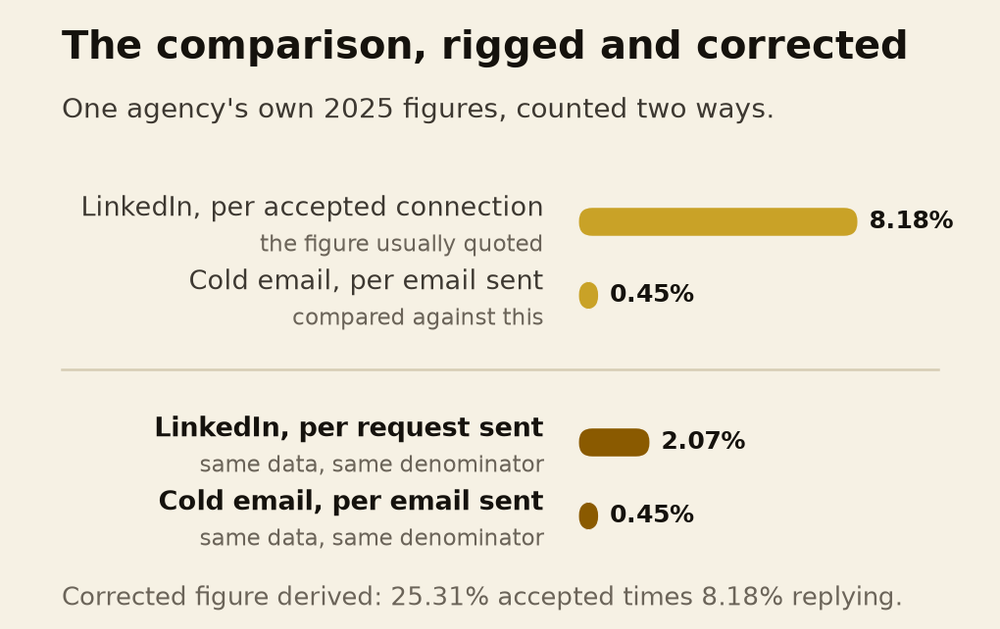
The sensitivity here is brutal. Another vendor's numbers, run through the same correction, give 5.3% per request instead of 2.07%. Same channel, same year, two vendors, a factor of two and a half apart purely on how they count. Any article that hands you a single clean number for either channel has not looked.
What LinkedIn actually publishes about limits
Very little, and much less than the ecosystem around it implies.
There is no published weekly connection request cap. LinkedIn's help page on invitation limits says restrictions exist to prevent misuse, that a restriction typically lasts one week, that support cannot shorten it and cannot even tell you why it was applied. No number anywhere. The "about 100 per week" figure that every guide repeats comes from automation vendors measuring their own users.
What LinkedIn does document is what triggers a restriction: sending many invitations in a short time, having many invitations ignored or left pending or marked as spam, and suspected automation. Durations run from a few hours for a first offence to a month for too many outstanding invitations, and repeated suspensions can mean permanent restriction.
Read that middle one again. Ignored invitations count against you. Email has no equivalent mechanic. Nobody's mailbox provider punishes you because a recipient did not reply. On LinkedIn, a low acceptance rate is itself a risk to the account, which means the platform structurally punishes untargeted volume in a way email does not.
Automation is prohibited outright. LinkedIn's policy says it does not permit any third party software that scrapes, automates or modifies the site, that accounts using such tools risk being restricted or shut down, and that the tools may stop working without notice. Every LinkedIn automation product in the cost comparison below is against the terms of the platform it runs on. That is not a grey area in the documentation; it is only grey in practice.
Personalised notes are rationed. LinkedIn's current help page says non-Premium users get up to three connection requests a month carrying a personalised message, at 200 characters each. Premium has no cap. If your whole strategy is a personal note with every request, you are buying Premium whether you planned to or not.
InMail credits are capped and cannot be bought. Sales Navigator gives 50 a month at every tier, accumulating to a maximum of 150, and LinkedIn states plainly that you cannot purchase more. A credit comes back if the InMail is answered within 90 days. Worth noting that LinkedIn's own pages contradict each other on whether unused credits expire, which tells you something about how carefully this is documented.
What each channel actually costs
I priced both stacks from published rates in October 2026, for a scenario of 1,000 new prospects a month.
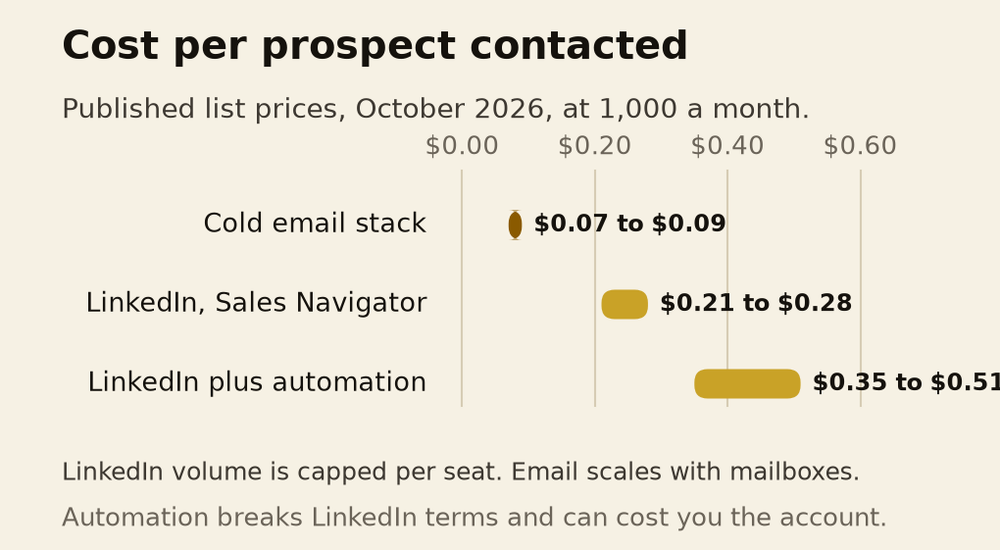
Email needs a sequencer, mailboxes, domains and verification. A three-step sequence to 1,000 people is 3,000 sends, which at a conservative 30 a day per mailbox across 22 working days needs about five mailboxes and two or three domains. That comes to roughly $67 to $89 a month, or about $0.07 to $0.09 per prospect.
LinkedIn needs Sales Navigator at $89.99 to $119.99 per seat. If the practical ceiling really is around 100 requests a week, one seat reaches about 433 prospects a month, so $0.21 to $0.28 per prospect. Add an automation tool and it is $0.35 to $0.51. To touch 1,000 prospects a month you need roughly two and a half seats.
So LinkedIn costs three to six times more per prospect contacted and delivers under twice the reply rate per prospect. Run that through to cost per reply and email comes out cheaper, somewhere around $5 to $7 against roughly $10 to $25.
That is the opposite of where the uncorrected comparison pointed, and it is worth saying plainly: on cost alone, email wins.
The deciding factors are the two things that are not on the invoice.
LinkedIn volume is capped per seat and the cap is enforced by a platform that can remove your account. Email volume scales with mailboxes, and the penalty for overdoing it is a damaged sending domain, which is recoverable and replaceable. Those are very different risk profiles. One of them can end a personal brand you spent ten years building.
I should be honest about how unstable the cost-per-reply maths is. Run the same price list against the different published email benchmarks and the cost per reply ranges from $0.65 to $12.00. An eighteen-fold spread, from the price list alone, because the benchmarks disagree. Anyone who gives you a confident cost-per-meeting comparison between these channels is picking the benchmark that supports their conclusion.
Has anyone actually tested both on the same people
I went in believing nobody had published this. I was partly wrong, and the correction is more useful than my original claim.
No randomised controlled B2B test exists, as far as I can find. Nobody has taken one prospect list, randomly split it into email only, LinkedIn only and both, held the copy and cadence constant, and published the result. I looked, and I should say that I searched the general web rather than academic databases directly, so this is "not found" rather than "does not exist".
But one same-audience dataset does exist. A recruiting software company contacted more than 165,000 candidates on both channels over a year and published the comparison. LinkedIn drew about 3.8 times as many replies as email.
The headline is not the interesting part. This is:
- 78% of responders replied only on LinkedIn.
- 17% replied only on email.
- About 5% replied on both.
- Interest quality was almost identical: 57% of email replies showed genuine interest against 58% of LinkedIn replies.
The channels are not better and worse versions of each other. They reach largely different people, and the people they reach are equally interested.
That reframes the whole question. If four out of five responders are reachable on one channel only, then running one channel means writing off most of your addressable list, regardless of which channel's average looks better.
The caveats are real and I will not bury them: it is recruiting rather than B2B sales, it is observational with no random assignment, the vendor sells recruiting software, and reply is not defined. It is the best thing published and it is still not a controlled test.
What I have measured, and what I have not
I want to be exact about this, because the asymmetry matters and most comparisons hide theirs.
Email, measured. Across 44 campaigns for one client we sent 470,293 emails for a 2.12% reply rate. The platform's own export prints it.
LinkedIn, attested. My working benchmark is 500 to 800 connection requests per account per month, 15 to 30% accepted, 40 to 60% of accepted people replying, and roughly 10 to 15% of replies booking a call. That comes from running LinkedIn outreach for 30-plus teams over about five years, and I stand behind it. It is my own figure from my own operations, not an export I can hand you.
That is a weaker form of evidence than the email number, and you should discount it accordingly. I would rather say so than present both in the same typeface and let you assume they carry equal weight.
And then discount it again, because my own numbers do not agree with the published ones. Run my benchmark through: 15 to 30% accepted, times 40 to 60% of those replying, gives 6% to 18% of connection requests ending in a reply. The published figure I used above is 2.07%.
That is a gap of three to nine times, and I am not going to paper over it. Three explanations, and I cannot separate them: my accounts run far lower volumes with far more targeting than a platform average; my benchmark may be optimistic in the way every operator's recalled numbers are; or the published figure is measuring a different population. Probably some of all three.
What it tells you is to use the 2.07% when you are planning, because it is the conservative one and it comes from a dataset rather than a memory.
One measured outcome I will put weight on: a software house closed more than seven deals through LinkedIn in about two years, from two or three profiles, each over $15,000, the largest $30,000. Seven deals in two years is a trickle, not a machine. It is also roughly $120,000 of work from a channel that cost a few hundred dollars a month, which is why I keep running it.
Choosing, for an actual business
- If your buyer is senior and the deal is over about $15,000, start with LinkedIn. The cost per prospect is irrelevant at that deal size, and the acceptance step filters for people who at least recognise your category.
- If you need volume and your buyer is reachable by title, start with email. It scales with infrastructure rather than with seats, and nothing about it threatens an account you cannot replace.
- If you can afford one of them properly or both of them badly, pick one. Both channels punish thin effort, and LinkedIn punishes it structurally by counting your ignored invitations against you.
- Do not run automation on a LinkedIn account that matters. It is against the terms, the penalty can be permanent, and the tool can break without notice. If you accept that risk, accept it on an account you can lose.
- Run both only when you can genuinely vary the message per channel. Posting the same paragraph into both is how you discover that neither works.
- Measure per prospect, not per message. It is the only denominator that survives a comparison between a channel with an acceptance step and one without.
The honest summary is that the one dataset covering the same people on both channels says most responders are reachable on exactly one of them.
So the real question is not which channel wins. It is which half of your market you are currently choosing not to contact.

Ahmad Zabir
GTM expert and marketing consultant for SaaS companies, software houses and fitness brands. He diagnoses why growth stalls, designs the fix, and trains the team to run it.
One teardown a month
Research like this, before it goes public. No cadence promises I will not keep.
Do Cold Emails Still Work in 2026
Published cold email reply rates range from 0.45% to 4.5% for the same channel in the same year. The gap is almost entirely arithmetic, not performance, and one agency moved its own number thirteen times by changing the denominator.
Cold Email Deliverability: Placement Problem or Targeting Problem
A placement problem and a targeting problem produce the same symptom and need opposite fixes. How SPF, DKIM and DMARC actually work, why bounce rate measures neither, and the twenty minute test that separates them.
How Many Cold Emails You Can Send Per Day, Per Domain
No mailbox provider publishes a safe cold email volume. What Google and Microsoft actually document, why the published vendor caps disagree by eight times, and how to tell which of your domains is actually burned.
What Is a GTM Agency, and What It Is Not
A GTM agency owns the whole path from product to collected cash, across positioning, demand, sales and revenue operations. How that differs from a marketing agency, a sales strategy and revenue operations, the four ways it breaks, and when you actually need one.
Not sure which of these you actually need?
Bring your funnel and your numbers. You leave knowing what to fix first and what to ignore.
Apply for a Consult