
How Software Houses Get Clients Beyond Upwork and Referrals
When Upwork and referrals are most of your revenue. Upwork's take rate has risen from 15.4% to 19.6% while the platform shrank, and the real constraint is that your best salesperson is also your most billable engineer.
If most of your revenue comes from two old marketplace relationships and word of mouth, you already know the problem. You do not have a sales problem. You have a concentration problem that will become a sales problem on somebody else's schedule.
This is written for development shops and IT services firms. If you sell subscriptions, most of it will not apply.
What the data actually shows, and what it does not
I will be straight about the evidence, because this topic is thick with confident numbers that do not survive checking.
There is no published channel mix for software development firms. I looked hard. What exists covers digital and marketing agencies, which is adjacent but not the same business.
From that adjacent data, in a survey of 612 digital agencies, 66% named client referrals as their single biggest source of new business. A separate industry survey put it at 75%. Both are consistent with what every dev shop owner will tell you over coffee.
Two findings from the same body of work are more useful than the referral number, because they explain it.
- 79% have no dedicated marketing staff.
- 70% have no dedicated full-time salesperson.
Referrals dominate not because referrals are powerful, but because they are what happens when nobody is assigned to anything else.
One more, which should shape your expectations: of agencies that had tried outbound, 9% called it very effective and 33% called it not effective. The channel works, and it does not work easily, and anyone telling you otherwise is selling outbound.
The marketplace is getting more expensive, measurably
If a chunk of your revenue runs through Upwork, this is the part worth your attention, because it is from their own filings rather than anyone's opinion.
Upwork's marketplace take rate: 15.4% in 2023, 18.0% in 2024, 18.7% in 2025, and 19.6% in the second quarter of 2026.
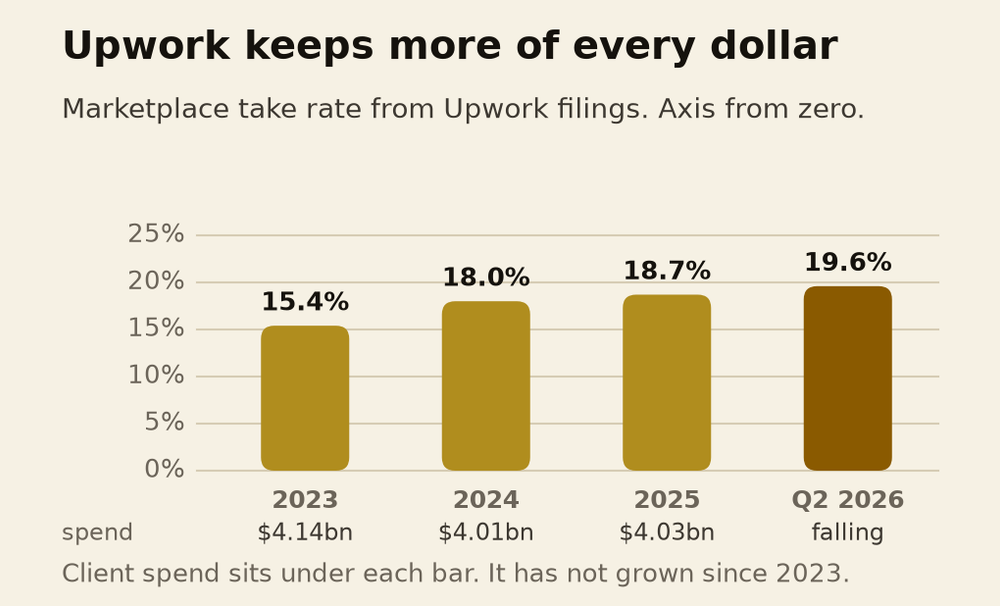
Now put that next to the volume. Gross services volume, which is what clients spend, was $4.142 billion in 2023 and $4.028 billion in 2025. Active clients went from 851,000 to 785,000, and to 763,000 by mid 2026.
The take rate is rising while the platform shrinks. Upwork's own filing attributes the increase to "the growing contributions from ads and monetization products."
That matters for how you budget. The take rate is not just the service fee. It includes Connects, the paid credits you spend to submit proposals, plus ads and memberships. So your true cost of selling on the platform is the fee plus what you spend bidding, including on the jobs you lose.
One technical note, because I checked and it is a trap: if you compute the take rate yourself by dividing marketplace revenue by total volume, you get about 17%. Upwork's denominator excludes enterprise volume, so doing your own arithmetic understates the rate by one and a half to two and a half points. Use their reported figure.
None of this means leave. It means the platform is becoming a more expensive channel on a schedule you do not control, and a business with 70% of revenue there is making a bet on somebody else's pricing committee.
About the concentration number
You will be told that more than 10% of revenue from one client is dangerous.
That threshold comes from an accounting standard. US public companies must disclose when a single customer accounts for 10% or more of revenue. It marks where investors want to be told, not where a business becomes fragile. Somewhere along the way a disclosure rule became a risk benchmark, and there is no research behind that promotion.
There is no authoritative figure for how much is too much. What there is, is a useful illustration from a real filing. One internet services firm reported its five largest clients at 56% of revenue in one year and 30% the next, but 57% in a single quarter of that second year. Concentration is not stable, and an annual average can hide a quarter where you were almost entirely dependent on a handful of accounts.
So the honest guidance is not a percentage. It is: what happens to payroll if the largest one stops in ninety days? If the answer is layoffs, the number is too high regardless of what it is.
The actual reason this is hard
Here is the structural thing, and it is not a lack of knowledge about marketing.
In professional services the person who can sell the work is usually the person who does the work. Research across 1,769 partners at 23 professional services firms describes exactly this: unlike corporate sellers, partners are doer-sellers, carrying business development and delivery at the same time.
The same study identifies a profile it calls the Expert, around 20% of partners, described as reluctant business developers who rely on their reputation to bring work in. Every dev shop founder recognises that person. Many are that person.
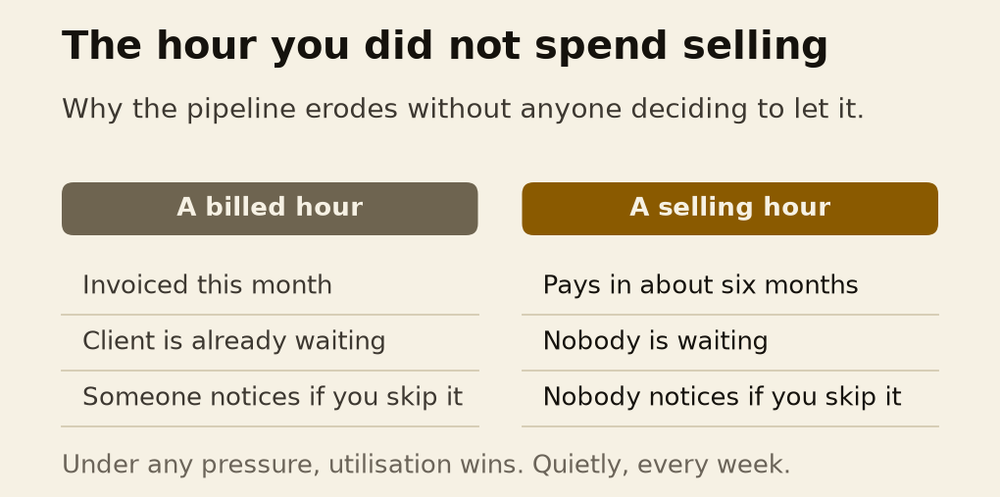
The consequence is an arithmetic one. An hour spent selling is an hour not billed, and the billed hour has an invoice attached this month while the sold hour pays in six. Under any pressure, utilisation wins. It wins quietly, every week, and the pipeline erodes without anyone deciding to let it.
This is also why hiring a business development person so often fails in these firms. The new hire cannot have the conversation, because the conversation requires technical credibility they do not have. So they book meetings the founder must attend, which does not reduce the founder's time, and six months later everyone concludes business development does not work here.
Your sales problem is a capacity allocation problem wearing a costume.
What actually works, in order
Given all of the above, here is what I would do, roughly in this sequence.
Protect a fixed block of selling time and bill against it. Not "I will do business development when things are quiet", because things are never quiet. Book it like a client. Four hours a week, same two slots, and treat cancelling it as cancelling on a client. This is the single highest-leverage change available to most owners and it costs nothing.
Make the founder's technical credibility the asset rather than the bottleneck. The reason the business development hire fails is that the credibility cannot be delegated. But it can be published. Write the thing you would say on the call, once, and let it work while you are billing. This is slow and it compounds, which is the opposite of how it feels in month one.
Go narrow enough that a referral can describe you. The reason referrals arrive for some firms and not others is usually that the referrer cannot complete the sentence "they do...". "Custom software" does not complete it. "They rebuild broken Shopify checkouts for subscription brands" does.
Run outbound, with realistic expectations. It can work and it mostly does not, as the 9% figure shows. What it needs is a list narrow enough that your first line could only have been written to that company, which is the same discipline as the point above.
Use LinkedIn for the deals that are worth a slow channel. A software house I worked with closed more than seven deals in about two years through LinkedIn, from two or three profiles, each over $15,000, the largest $30,000. That is roughly $120,000 of work from a channel costing a few hundred dollars a month. It is also a trickle, not a machine. At your deal sizes a trickle is fine. Say it out loud so nobody expects a flood.
Keep the marketplace running while you build. The mistake is treating this as a switch. The take rate is rising, which argues for reducing dependence, not for walking away from revenue you currently have.
What to expect, honestly
A few calibrations so you can tell progress from failure.
Industry data puts the average custom software project at around $132,480 over roughly 13 months, drawn from client reviews on a directory, which skews toward firms that solicit reviews. Treat it as an order of magnitude.
On win rates, among digital agencies: 12% win more than three quarters of qualified opportunities, 32% win half to three quarters, 39% win a quarter to a half, and 17% win under a quarter. If you are converting one qualified lead in three you are doing fine, and the instinct that you are bad at closing is usually wrong.
And on timelines, expect to see nothing for a quarter. You are rebuilding a channel, and the first version of any channel is bad. The question in month three is not whether revenue moved. It is whether you held the four hours.
The one thing to do this week
Open your revenue by client for the last twelve months and work out what percentage comes from your largest account, then your largest three.
If the top one is over a third, that number is your actual strategy document. Everything in this article is downstream of what you decide to do about it.
And if you have been meaning to start for a year, the thing stopping you is not knowledge. It is that next week is busy, and it will be busy the week after.
Book the four hours now, before you close this.

Ahmad Zabir
GTM expert and marketing consultant for SaaS companies, software houses and fitness brands. He diagnoses why growth stalls, designs the fix, and trains the team to run it.
One teardown a month
Research like this, before it goes public. No cadence promises I will not keep.
Marketing Agency or In-House: The Test That Answers It
No study compares the outcomes, so stop looking for one. The make-or-buy test that actually answers it, why clients leave agencies over budget cuts rather than performance, and when the answer is neither.
How to Judge an Outsourced SDR Team in 30 Days
You cannot see effort or quality, and revenue is two quarters away. A 30-day scorecard and written kill criteria for an outsourced SDR or lead generation trial, built on what the economics of information actually predict.
Find the Broken Layer in Your Funnel, Using Your Own CRM
Traffic looks fine, revenue is flat, and nobody can say why. How to diagnose it from your own CRM: confidence intervals on small samples, Simpson's paradox, survivorship, and where deals pile up versus vanish.
Pipeline Stage Exit Criteria a Rep Cannot Fake
Your forecast lies because your stages measure your own team's activity. Peer-reviewed evidence that reps distort deal ratings in both directions, and how to write exit criteria from evidence only the buyer can produce.
Not sure which of these you actually need?
Bring your funnel and your numbers. You leave knowing what to fix first and what to ignore.
Apply for a Consult