
How to Judge an Outsourced SDR Team in 30 Days
You cannot see effort or quality, and revenue is two quarters away. A 30-day scorecard and written kill criteria for an outsourced SDR or lead generation trial, built on what the economics of information actually predict.
You cannot see effort. You cannot see quality. You will not see revenue for two quarters. And the agency knows all three of those things before you sign.
That is not cynicism, it is the structure of the transaction, and economists worked out what it does to a market sixty years ago. The good news is that the same work tells you what a contract has to look like to survive it.
The statistic everybody quotes, examined
If you have researched this at all you have met the claim that 67% of outsourced SDR programmes fail.
I traced it. The source is a survey of over 1,200 respondents run by a well-known SaaS commentator. The published results are that 7% said outsourced SDRs "really worked" and 26% said they "sort of worked".
That is it. The 67% is the arithmetic remainder, and the word "fail" was added by whoever repeated it first. The original never characterises the third group, and the respondents were a self-selected pool of SaaS founders.
So the honest version is: in one skewed survey, one in three people reported some degree of success. That is worse than the vendors imply and softer than the statistic that gets quoted at you.
I am spending a paragraph on this because the number gets used by both sides. Agencies cite the 33% success to argue their category is hard and they are the exception. Buyers cite the 67% to negotiate. It is the same unreliable number.
Why this market behaves badly
George Akerlof published a paper in 1970 about used cars that explains your SDR trial precisely.
When buyers cannot distinguish quality before purchase, they will only pay the average price for the average quality. Sellers of genuinely good product cannot command a premium, because nothing they say is verifiable at the point of sale. So good sellers leave or cut corners, average quality falls, buyers lower their expectations again, and the cycle continues.
Outsourced SDR has every feature of that market.
- Quality is invisible before purchase. Every deck has case studies. None can be verified.
- The feedback loop is longer than the contract. Pipeline quality shows up in months four to six. Many trials are three months.
- The output is easy to counterfeit. A meeting is a calendar entry. Making calendar entries is not hard.
When the buyer cannot grade the product, the market stops rewarding the thing you actually want and starts rewarding the thing you can count.
What you are paying for, and what you will get
The second piece of theory is more actionable. In 1991 Holmström and Milgrom formalised what happens when an agent works on several tasks and you measure only one of them: effort moves to the measured task and away from the unmeasured ones, even when the unmeasured ones matter more.
Apply it to a per-meeting contract.
Measured: number of meetings booked. Unmeasured: whether the person has budget, whether they have the problem, whether they will show up, whether your AE's hour was well spent, whether your brand got burned on the way.
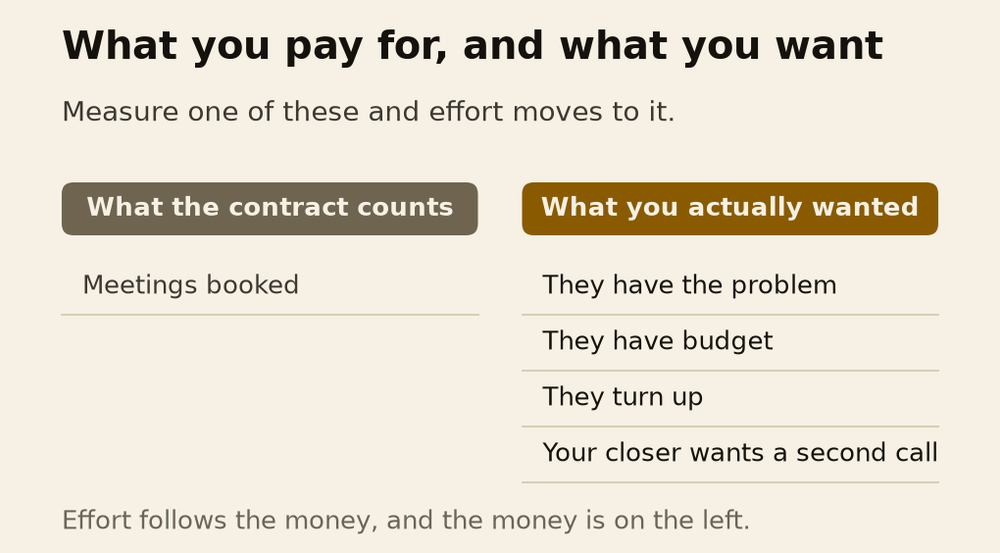
An agency paid per meeting that books low-quality meetings is not cheating you. It is doing exactly what your contract describes. You wrote a specification for calendar entries and received calendar entries.
This is also why "we'll just pay per qualified meeting" fails more subtly than people expect. Now you are negotiating the definition of qualified, every week, with someone whose income depends on the answer. You have not removed the problem, you have moved it into a weekly argument.
Calibrate against what in-house actually costs
You cannot judge the agency without knowing the alternative, and here the data is genuinely good.
A 2025 study of 351 B2B companies, median revenue $47 million, median deal size $50,000, found:
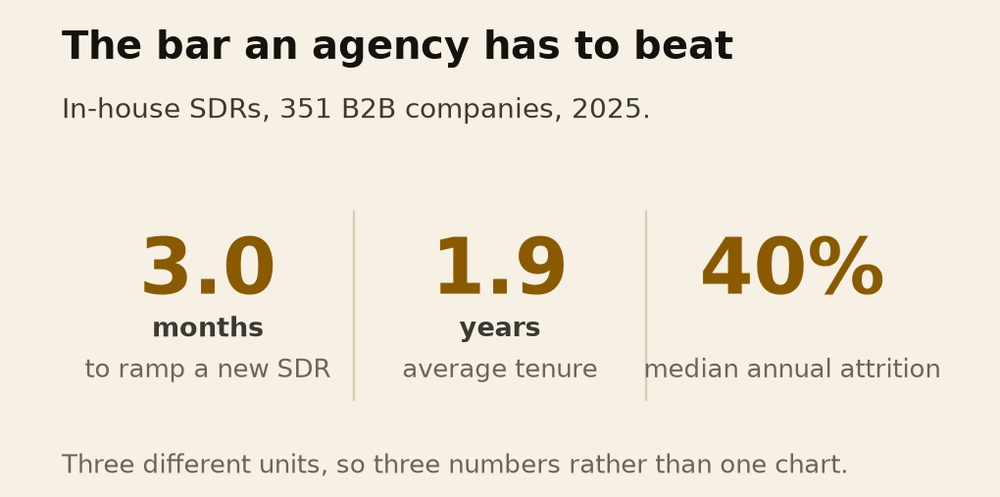
- Average ramp time: 3.0 months. That is the fastest it has been since 2010, when the same series started tracking it.
- Average tenure: 1.9 years.
- Median annual attrition: 40%, with the middle half of companies between 21% and 57%.
Read those three together. You hire an SDR, wait three months for them to become useful, and then at the median company two in five of that year's seats turn over. That is a company rate, not one person's odds, but it is the number your payback assumption has to survive. The payback window on an in-house SDR is narrower than most plans assume.
That is the bar the agency has to beat, and it is lower than agency-sceptics think. It is also the labour market the agency is hiring from, which is the part agencies do not volunteer: their reps churn too, and your account gets reassigned.
So a fair question on a sales call is not "how experienced is your team". It is "what is your rep attrition, and what happens to my account when my rep leaves?"
The 30-day scorecard
Here is what you can actually judge in the first month, separated honestly into what the data can support and what it cannot.
Week one, before anyone dials. You are judging inputs, which is all that exists yet.
- Have they written an ICP definition you disagree with in at least one place? Total agreement in week one means they wrote down what you told them. You are paying for a view.
- Can they name the three reasons your best customers bought, from your own closed-won deals, without you supplying them?
- Have they asked for CRM access and actually looked? Most have not by day seven.
- Is there a named rep, with a name, and is that person on the kickoff call?
Weeks two and three. Leading indicators, not outcomes.
- Read ten actual sent messages. Not templates, sent ones. This is the single most informative thing you can do in the whole engagement and almost nobody does it.
- Sit on one meeting they booked. One is enough to know.
- Check list quality against your exclusion rules. Existing customers, current opportunities, churned accounts, competitors. Finding your own customers on their list in week two is common and tells you how the list was built.
- Count touches per account. A high meeting count from a low touch count usually means the list was warm, not that the outreach was good.
Day 30. The decision.
- Meetings held, not booked. The gap between the two is the honest quality signal, and it is available at thirty days. A no-show rate over roughly a third means the qualification is theatre.
- Of meetings held, how many did your AE want a second call with? This is the only quality metric that exists this early, and your AE already knows the answer.
- How many were already in your CRM? Pipeline you already had, re-sourced, is not pipeline.
Kill criteria, written before you start
Agree these in advance and in writing, because deciding in month two with sunk cost in the room is a different exercise entirely.
- Zero AE-approved second calls by day 30. Not zero meetings. Zero that your closer wanted to continue.
- No-show rate above a third, measured as meetings booked minus meetings held, over the booked. Needs at least ten booked before the number means anything.
- You cannot get ten sent messages when you ask. This is a process failure and it is disqualifying on its own.
- The named rep changed in month one without you being told before it happened.
- They have not asked you a single question you found uncomfortable. A vendor who never pushes back is managing you, not your pipeline.
Then the harder half: write down what you will NOT kill for. Low meeting volume in month one is normal. A bad first week of copy is normal. Deals not closing is not evidence of anything yet and will not be for two quarters.
What this looks like when it goes wrong quietly
The most expensive version of this I have seen was not an agency booking junk meetings. It was a programme that produced perfectly reasonable meetings, at a reasonable cost, for a product whose economics could not support the channel.
In a different context I watched eleven acquisition experiments run against one offer. The best of them produced leads at $8.22. One of them produced customers at $624.59 each on a one-dollar trial, which was the most expensive failure in the set and took real money to learn.
The lesson transfers exactly. Before you judge the vendor, check that the unit economics can survive any vendor. If your average deal is $4,000 and your sales cycle is five months, a $5,000 a month SDR retainer costs $60,000 a year and needs fifteen closed deals at full price just to cover itself, before margin, before your team's hours, and before the five month cycle delays every one of them.
Work out that ratio first. If the gap is more than about two times, no SDR agency closes it, and you are about to spend six months blaming a supplier for arithmetic you could have done in an afternoon.
What to ask on the sales call
- What is your rep attrition, and what happens to my account when my rep leaves?
- Show me ten messages you sent for a client in my space last month, with the names removed.
- What percentage of meetings you booked last quarter were held, across all clients?
- What would make you tell me this is not working, and when?
- Who writes the copy, and are they the person on this call?
- What are you not going to do?
That fourth one matters most. A vendor with no stated failure condition has not thought about failure, and you will be the one who discovers it.
Thirty days will not tell you whether this works. It will tell you whether these are people who know what they are doing, which is a different question and the only one you can actually answer that fast.
Answer that one, and give the rest two quarters.

Ahmad Zabir
GTM expert and marketing consultant for SaaS companies, software houses and fitness brands. He diagnoses why growth stalls, designs the fix, and trains the team to run it.
One teardown a month
Research like this, before it goes public. No cadence promises I will not keep.
How Software Houses Get Clients Beyond Upwork and Referrals
When Upwork and referrals are most of your revenue. Upwork's take rate has risen from 15.4% to 19.6% while the platform shrank, and the real constraint is that your best salesperson is also your most billable engineer.
Marketing Agency or In-House: The Test That Answers It
No study compares the outcomes, so stop looking for one. The make-or-buy test that actually answers it, why clients leave agencies over budget cuts rather than performance, and when the answer is neither.
Find the Broken Layer in Your Funnel, Using Your Own CRM
Traffic looks fine, revenue is flat, and nobody can say why. How to diagnose it from your own CRM: confidence intervals on small samples, Simpson's paradox, survivorship, and where deals pile up versus vanish.
Pipeline Stage Exit Criteria a Rep Cannot Fake
Your forecast lies because your stages measure your own team's activity. Peer-reviewed evidence that reps distort deal ratings in both directions, and how to write exit criteria from evidence only the buyer can produce.
Not sure which of these you actually need?
Bring your funnel and your numbers. You leave knowing what to fix first and what to ignore.
Apply for a Consult