
Marketing Agency or In-House: The Test That Answers It
No study compares the outcomes, so stop looking for one. The make-or-buy test that actually answers it, why clients leave agencies over budget cuts rather than performance, and when the answer is neither.
There is no study showing that agencies outperform in-house teams, or the reverse. I went looking properly. The entire category is prevalence surveys and satisfaction scores.
So anyone answering this question with evidence is answering a different question. What you can do instead is work out which one your specific situation calls for, and there is a ninety year old piece of economics that does it cleanly.
What the research actually contains
Worth knowing how thin the ground is before anyone quotes a statistic at you.
Prevalence is well measured. One association has surveyed its members every five years since 2008. In-house agency adoption went from 42% in 2008 to 58% in 2013, 78% in 2018 and 82% in 2023. The same survey found 92% of those members still use external agencies. Sample was 162 respondents, all large brand advertisers, self-selected.
Budget split is measured. One analyst firm's 2025 numbers put agency spend at 20.7% of the marketing budget and in-house labour at 21.9%. Within about a point of each other.
Outcomes are not measured at all. No study I could find compares performance, retention or return between the two models with anything resembling a controlled design. There are satisfaction surveys with samples of 32 and 42 people. That is the state of the art.
The most repeated debate in marketing has no empirical literature behind it. Both sides are reasoning from anecdote, including the people selling you one of the options.
The question that actually has an answer
In 1937 Ronald Coase asked why firms exist at all. If markets are efficient, why does anyone employ anybody rather than contracting every task?
His answer was that using the market has costs of its own: finding the right supplier, negotiating, writing contracts, monitoring the work, handling what the contract did not foresee. A firm exists wherever doing it internally is cheaper than paying those costs. Oliver Williamson later built this out into a framework for deciding case by case, and won a Nobel for it.
Three factors decide which side of the line any given activity falls on.
Asset specificity. How much of the knowledge required is specific to you and useless elsewhere? Running Google Ads is a general skill. Understanding why your enterprise deals stall in procurement at month four is not. High specificity favours in-house, because an outsider has to rebuild that knowledge and it walks out when the contract ends.
Frequency. Is this continuous or occasional? Daily work favours employment. Episodic work favours buying, because you pay only when you use it.
Uncertainty. Can you write down in advance what good looks like? Media buying has measurable outputs and can be contracted. "Figure out why our positioning is not landing" cannot be specified in advance, and anything you cannot specify is hard to buy well.
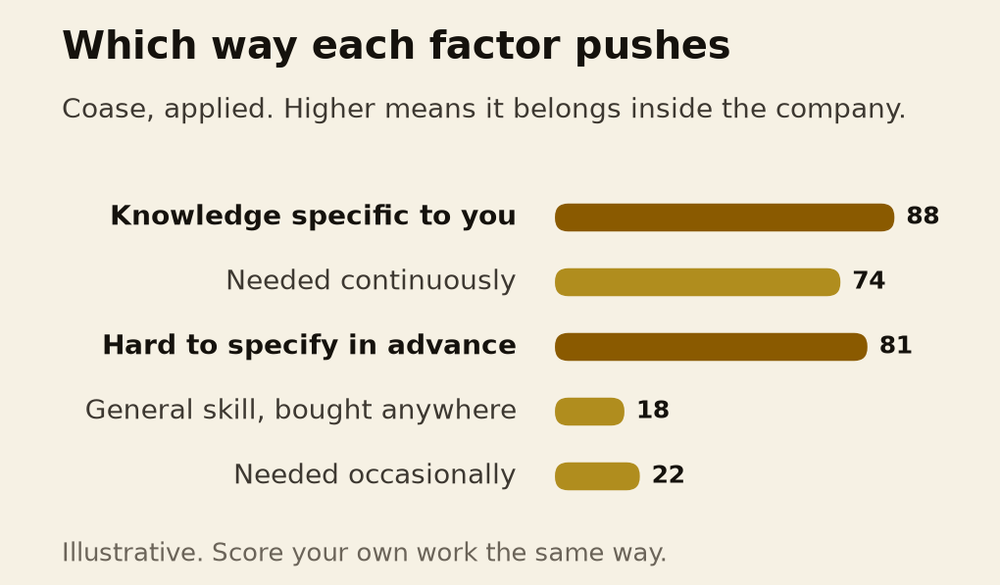
Run your actual situation through those three and the answer usually falls out without argument. And notice that the framework predicts hybrid, which is exactly what 82% and 92% describe. Most companies are not choosing. They are allocating activity by activity, which is what the theory says they should do.
Why agency relationships actually end
This one surprised me, and it reframes the decision.
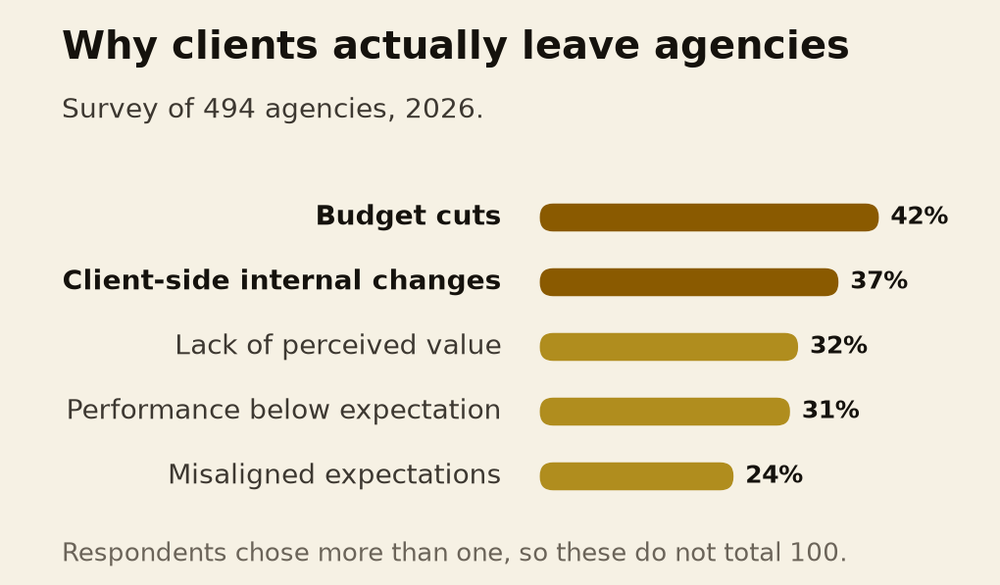
In a 2026 survey of 494 agencies, the reported reasons clients leave were:
- Budget cuts: 42%
- Client-side internal changes: 37%
- Lack of perceived value over time: 32%
- Performance below expectation: 31%
- Misaligned expectations at onboarding: 24%
Performance is fourth. The top two reasons have nothing to do with the work at all.
Client tenure from the same survey: 43% last two to five years, 24% last one to two, 19% more than five, 12% six to twelve months, 2% under six months.
The practical reading is that an agency relationship is more fragile to your budget cycle and your reorganisations than to its own results. If you are about to go through either, that is an argument for in-house that has nothing to do with quality. And if you are an agency reading this, your churn is substantially a function of your client's internal weather, which is a deeply annoying thing to be true.
The number that actually decides it
Here is the thing both sides avoid, because it is boring.
In the United States, benefits are about 30% of total compensation in private industry, and roughly 30.5% in professional and business services. Note the denominator, because it is easy to get wrong: that is a share of the total, not a markup on the salary. A $90,000 salary therefore implies total compensation of about $128,600, not $117,000, before you have bought a single tool or spent an hour managing anyone.
Compare that honestly against a retainer and the gap is smaller than the salary number suggests. What usually decides it is not the money, it is the three things the invoice does not show.
- Management load. A junior in-house hire needs direction from someone who knows the work. If that person does not exist in your company, you have not bought a marketer, you have bought a second problem.
- Bench depth. An agency has a designer, a media buyer and an analyst. One hire has one skill set, and you will discover which one it is not in month three.
- Knowledge retention. The in-house person accumulates understanding of your business. The agency accumulates it too, and then it leaves with them. This is Coase's asset specificity showing up as a leaving-do.
The test I actually run
Everything above is framing. This is the part that answers it in an afternoon, and it is deliberately not about agencies at all.
Name which layer is broken before you decide who fixes it.
- Positioning and offer. Who it is for, what it replaces, why now.
- Demand. Paid, outbound, organic, partnerships.
- Sales. Turning interest into a signature.
- Revenue operations. The CRM, the pipeline, the reporting that says which of the above worked.
Then match.
- Broken at demand, and you know it is demand? Buy it. Media buying and outbound are specifiable, measurable and episodic. This is the textbook case for an agency, and hiring for it is usually slower and more expensive.
- Broken at positioning? Neither, yet. An agency cannot fix positioning they do not believe, and a junior hire cannot fix it at all. This is a founder's job, possibly with a consultant for a few weeks.
- Broken at sales? In-house, almost always. Sales process knowledge is the most company-specific asset on the list.
- Broken at revenue operations? Buy the build, hire the run. The setup is a project. Keeping it honest is continuous.
- Cannot name the layer? That is the actual answer, and it is neither. Diagnose first, because a hire or a retainer aimed at the wrong layer costs you the same whether or not it was ever going to work.
A case where the answer was neither
I inherited an account where everyone assumed the agency arrangement was the problem, because revenue was flat and the obvious suspect is whoever runs acquisition.
Acquisition was fine. Leads were coming in at $3.77 each across $49,533.87 of spend, thirteen thousand of them. That is a good number by any standard and there was no version of this where firing the media buyer helped.
The problem was two layers down, in operations, where seventeen automations had been built and not one had ever been switched on. Nobody had been asked to turn them on. It was not in a job description, in-house or outsourced.
Flat revenue behind cheap leads is almost never an acquisition problem, and it is almost always diagnosed as one.
So I will answer Bilal's question directly, because it is the one people actually want answered and agencies dodge it: yes, there are situations where I will tell you not to hire an agency. If your leads are cheap and your revenue is flat, hiring anyone to get you more leads is the most expensive possible response to the information you already have.
What to do this week
- Write down which layer is broken, in one sentence. If you cannot, that is your answer and the next step is diagnosis, not recruitment.
- Score the work on specificity, frequency and uncertainty. General, episodic and specifiable goes out. Specific, continuous and vague stays in.
- Cost it fully. Salary plus about 30%, plus tools, plus the hours of whoever will manage them. Then compare.
- Ask who will direct the hire. No answer means do not hire.
- Assume hybrid. The companies furthest along this road overwhelmingly run both, and they are not being indecisive.
- Before signing either, ask the supplier which layer they think is broken. If their diagnosis is always the service they sell, you have learned something free.
The debate is framed as a choice between two kinds of people. It is actually a question about which kind of knowledge the work requires, and whether that knowledge should still be in your building in two years.
Answer that, and the invoice stops being the interesting part.

Ahmad Zabir
GTM expert and marketing consultant for SaaS companies, software houses and fitness brands. He diagnoses why growth stalls, designs the fix, and trains the team to run it.
One teardown a month
Research like this, before it goes public. No cadence promises I will not keep.
How Software Houses Get Clients Beyond Upwork and Referrals
When Upwork and referrals are most of your revenue. Upwork's take rate has risen from 15.4% to 19.6% while the platform shrank, and the real constraint is that your best salesperson is also your most billable engineer.
How to Judge an Outsourced SDR Team in 30 Days
You cannot see effort or quality, and revenue is two quarters away. A 30-day scorecard and written kill criteria for an outsourced SDR or lead generation trial, built on what the economics of information actually predict.
Find the Broken Layer in Your Funnel, Using Your Own CRM
Traffic looks fine, revenue is flat, and nobody can say why. How to diagnose it from your own CRM: confidence intervals on small samples, Simpson's paradox, survivorship, and where deals pile up versus vanish.
Pipeline Stage Exit Criteria a Rep Cannot Fake
Your forecast lies because your stages measure your own team's activity. Peer-reviewed evidence that reps distort deal ratings in both directions, and how to write exit criteria from evidence only the buyer can produce.
Not sure which of these you actually need?
Bring your funnel and your numbers. You leave knowing what to fix first and what to ignore.
Apply for a Consult