
Pipeline Stage Exit Criteria a Rep Cannot Fake
Your forecast lies because your stages measure your own team's activity. Peer-reviewed evidence that reps distort deal ratings in both directions, and how to write exit criteria from evidence only the buyer can produce.
Your forecast is wrong because your stages measure your own team's activity instead of the buyer's behaviour.
A rep can send a proposal on a Tuesday afternoon with nobody's permission. If "proposal sent" moves a deal to stage three, and stage three is weighted at 40%, then your rep can manufacture forecast out of an afternoon.
They are not cheating. You built a number out of something they control, and then you asked them to hit it.
The evidence that reps distort stage inputs
This is usually asserted. It has actually been measured, once, properly.
A 2015 paper presented at AAAI studied the sales pipeline of a Fortune 500 B2B technology company, across 100,000 to 200,000 leads per product line per quarter. Among other things, it scored how well the sellers' own subjective ratings of their deals predicted the outcome.
The sellers' ratings scored between 0.586 and 0.665 on a measure where 0.5 is a coin flip.
A model built from profile data and interaction logs scored 0.701 to 0.741. The humans holding the relationship were barely better than chance, and worse than a model that never spoke to anyone.
The authors are direct about why, and this is the part worth reading twice. They describe sellers manipulating ratings in two opposite directions: some deals rated down "to avoid the attention and competition from other sellers", and others rated up because sellers "suffer pressure from their leaders, who set different subtle performance metrics".
Both distortions are rational responses to how the number is used. Neither is dishonesty. Both destroy your forecast.
There is a second, quieter finding in the same paper. Once the model's scores were shown to the sellers, the sellers' own accuracy improved, and they reported cross-checking the report before entering their ratings. The measurement changed the behaviour, which is either encouraging or ominous depending on your temperament.
Which law this actually is
Three ideas get blended into one quote here, and separating them tells you what to fix.
Campbell's law, from 1976, is the one that applies to stage criteria. Donald Campbell's actual wording:
The more any quantitative social indicator is used for social decision-making, the more subject it will be to corruption pressures and the more apt it will be to distort and corrupt the social processes it is intended to monitor.
Two claims, not one. The number gets corrupted, and the work behind the number gets distorted. A rep who needs three deals in stage three does not only mis-stage three deals. They also spend the week generating proposals nobody asked for.
Campbell, to his credit, called these "pessimistic laws" and described his own evidence as "predominantly anecdotal". The people quoting him are usually more confident than he was.
Goodhart's law is a different thing: a statistical relationship you estimated stops holding once you steer by it. Your stage-three deals historically closed at 40%; you start managing to stage three; the 40% stops being true. That is the forecast model degrading, not the rep misbehaving.
And the famous one-liner belongs to neither. "When a measure becomes a target, it ceases to be a good measure" was written by the anthropologist Marilyn Strathern in 1997, in a paper about audit in British universities. It is a compression of Goodhart that Goodhart did not write. Worth knowing before you quote it at your sales team.
Internal evidence and external evidence
The useful frame came from an unexpected place. Auditing solved this problem decades ago.
Audit standards grade evidence by its source. Information produced by the company being audited is weaker than information obtained from a knowledgeable source independent of that company. The whole discipline runs on that distinction.
Apply it to a pipeline and your stage criteria sort themselves instantly.
Internal evidence. The rep logged a call. The rep sent a proposal. The rep held a demo. The rep says the buyer is interested. Every one of these is produced entirely by the party being measured. In audit terms they are the weakest class of evidence there is.
External evidence. The buyer named a budget figure in writing. The buyer introduced you to the person who signs. Procurement issued a ticket number. The buyer's security team sent you a questionnaire. Legal returned redlines. The buyer put a date in their own calendar for a decision.
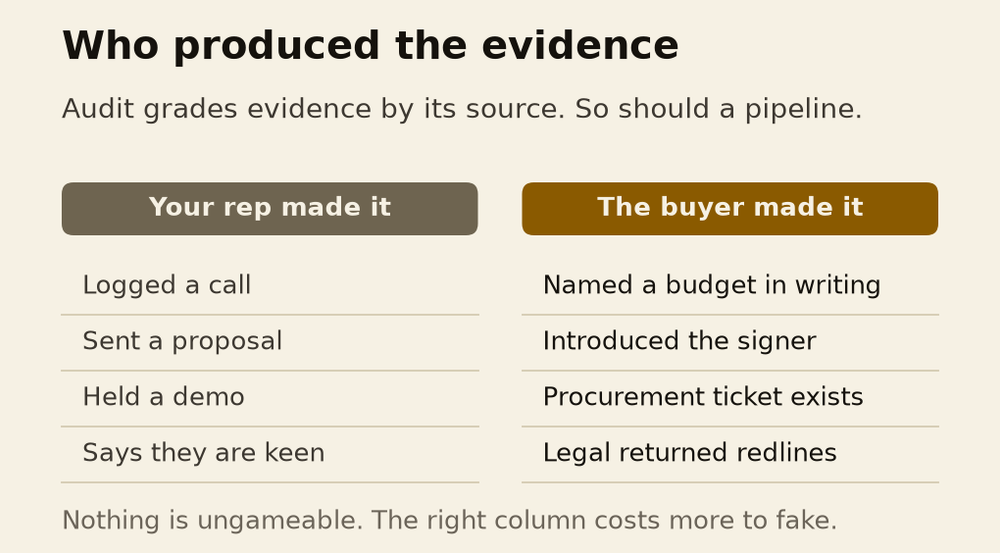
The second list has a property the first does not: the buyer had to spend something. Time, political capital, a colleague's attention. People do not spend those on vendors they are not seriously considering.
Now the honest caveat, because I promised one in the title and I am going to keep it.
Nothing is ungameable. A friendly contact will sign a mutual action plan to be nice. A champion will invent a budget number to keep you engaged. What external evidence does is raise the cost of producing the signal without the underlying reality. Activity is free to manufacture. A procurement ticket is not.
So the real design question is not "can this be faked". It is "what does faking this cost, and is that more than doing the work".
What I found in one pipeline
A client's CRM, inherited mid-engagement, had 1,523 opportunities in it.
Ninety-nine percent of them had never moved past stage one.
That is not a pipeline. It is a list of names in a field called pipeline. Every lead that arrived was created as an opportunity, because creating an opportunity was the activity being counted, and nothing downstream required anybody to do anything.
The weekly report showed a pipeline number in the millions. The number was real arithmetic over unreal objects.
What made it worse is that nobody was lying. The stage definitions genuinely permitted it. Stage one meant "we have them", and they did have them.
Writing criteria that survive contact with a rep
Here is the test I use. For each stage, name the artifact that must exist, and say who produced it. If the answer is "us", rewrite it.
Some before and after, from real pipelines.
- "Discovery call completed" becomes "buyer has stated the problem in their own words and we have it written down". Still soft, but it requires them to have said something.
- "Proposal sent" becomes "buyer has confirmed receipt and named who else needs to see it". The second half is the part that cannot be done alone.
- "Verbal commitment" becomes "the person who signs has been on a call with us". Verbal commitment from a champion with no authority is the single most common source of slipped forecasts I see.
- "Negotiation" becomes "their legal or procurement has touched the document". There is a ticket number or there is not.
- "Budget confirmed" becomes "a number appears in writing from their side". Not "they indicated it was in range".
Then, the rule that makes it stick: a stage can only advance when the artifact is attached. Not described, attached. If your CRM cannot enforce that, the criteria are a suggestion and will decay within two quarters.
How wrong forecasts actually are
Worth calibrating, because the numbers that circulate here are mostly untraceable.
The figure you will see most is that 79% of sales organisations miss forecast by more than 10%. I tried to find the original. It is attributed to a research firm that no longer exists under that name, and I could not locate the report, the date, or the sample. Same for a widely quoted "15% forecast within 5%" claim. These are repeated without sources, including by people selling forecasting software.
Gartner's "45%" figure is real but measures something else: it is the share of sales leaders and sellers who have high confidence in forecast accuracy. Confidence, not accuracy.
The best measurement I found comes from an analysis of 270,912 closed-won opportunities across more than a dozen companies. Ninety days before close, only 28.1% of deals were forecast within 5% of their final amount. Reps over-forecast at roughly twice the rate they under-forecast, and the average over-forecast was about $91,000 against about $47,000 for the average under.
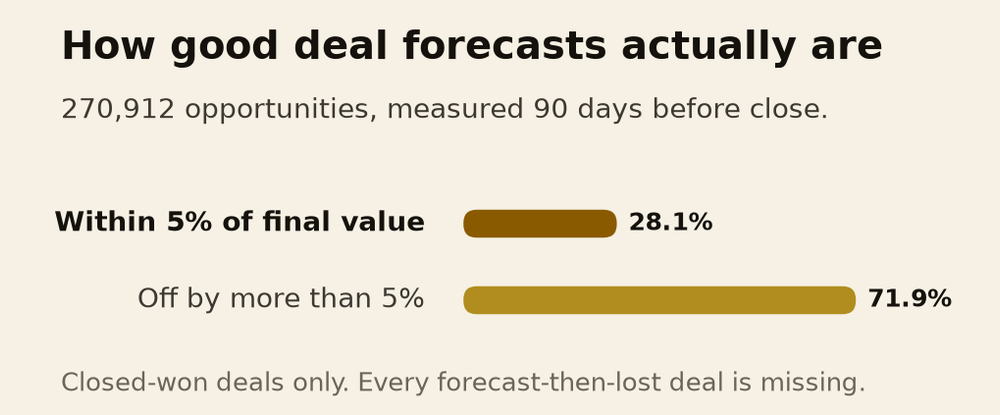
One structural caveat the original does not emphasise enough: that dataset contains only deals that closed won. Every deal that was forecast and then lost is missing. The real error is worse than 28.1% suggests, and nobody has published the version that includes the losses.
Re-staging without destroying your history
This is the question that stops most teams from fixing any of the above, and it is a fair one. If you redefine stage three today, every historic conversion rate through stage three becomes meaningless, and your CRO will ask why last year no longer matches.
What has worked for me:
- Add a new stage field. Do not overwrite the old one. Run both in parallel for a quarter. The old field keeps your history comparable; the new one starts accumulating honest data.
- Backfill only where the artifact already exists. If the procurement ticket is in the record, you can retro-stage that deal. If it is not, leave it blank rather than guessing. A blank is information.
- Expect your pipeline value to fall, and say so before it does. When criteria get stricter, deals fall back down the stages. If leadership is not warned, the first week of honest data looks like a collapse and the project gets reversed.
- Do not change criteria and compensation in the same quarter. You will not be able to tell which one moved the numbers, and your reps will assume the worst about both.
Where this started, since everyone gets it wrong
A short detour, because the history is repeated confidently everywhere and almost none of it survives checking.
You will read that E. St. Elmo Lewis invented the AIDA model in 1898. A 2024 historical study working from primary sources concludes there is no evidence Lewis invented it, and points to Arthur Frederick Sheldon as the likelier originator. Lewis's actual 1899 wording has three steps, not four. Four-step versions were circulating in sales training literature by 1903 and 1904, under different final letters: conviction in one, resolve in another.
And the funnel shape itself is usually credited to a 1924 book on bond salesmanship. I went looking for that diagram. The attribution traces to a single footnote, the quoted passage says only that a salesman should "visualize his whole problem of developing the sales steps", and I could not find anyone who has actually seen a funnel in that book. Meanwhile, diagrammatic charts of the steps of a sale were being sold commercially in 1905, two decades earlier.
None of that changes what you should do on Monday. I include it because the stage model gets treated as settled science handed down from a founder, and it is actually a hundred years of sales trainers disagreeing with each other.
That should make you more willing to change yours.
What to do this week
- Open your stage definitions and mark each one internal or external. Most teams find they have no external criteria at all.
- Rewrite the two stages closest to the close first. That is where forecast error costs the most and where buyer artifacts are easiest to require.
- Require the artifact, not the assertion. Attached, or the stage does not move.
- Count how many opportunities have never left stage one. If it is most of them, your pipeline number is describing a contact list.
- Stop quoting the 79% statistic. Nobody can find its source, including the people selling against it.
Your reps are not the problem. They are responding correctly to a measurement you designed.
Change what counts, and watch what they do next.

Ahmad Zabir
GTM expert and marketing consultant for SaaS companies, software houses and fitness brands. He diagnoses why growth stalls, designs the fix, and trains the team to run it.
One teardown a month
Research like this, before it goes public. No cadence promises I will not keep.
How Software Houses Get Clients Beyond Upwork and Referrals
When Upwork and referrals are most of your revenue. Upwork's take rate has risen from 15.4% to 19.6% while the platform shrank, and the real constraint is that your best salesperson is also your most billable engineer.
Marketing Agency or In-House: The Test That Answers It
No study compares the outcomes, so stop looking for one. The make-or-buy test that actually answers it, why clients leave agencies over budget cuts rather than performance, and when the answer is neither.
How to Judge an Outsourced SDR Team in 30 Days
You cannot see effort or quality, and revenue is two quarters away. A 30-day scorecard and written kill criteria for an outsourced SDR or lead generation trial, built on what the economics of information actually predict.
Find the Broken Layer in Your Funnel, Using Your Own CRM
Traffic looks fine, revenue is flat, and nobody can say why. How to diagnose it from your own CRM: confidence intervals on small samples, Simpson's paradox, survivorship, and where deals pile up versus vanish.
Not sure which of these you actually need?
Bring your funnel and your numbers. You leave knowing what to fix first and what to ignore.
Apply for a Consult