
Who Owns the Revenue Number
Revenue operations versus sales operations, and why the argument stays unresolved: bookings, billings, recognised revenue and collected cash are four different numbers with four different owners.
Ask four people in a company what revenue was last quarter and you can get four different correct answers.
Not four guesses. Four correct answers, because bookings, billings, recognised revenue and collected cash are genuinely different quantities, and the people measured on them are different people.
That is the real problem underneath every argument about revenue operations. Not org charts. Arithmetic.
Revenue operations vs sales operations
The comparison people actually search for, so here it is plainly before anything else.
Sales operations serves the sales team. Territory and quota planning, CRM administration for sellers, commission calculation, sales reporting, deal desk. The customer is the sales organisation.
Revenue operations serves the revenue path. Marketing operations, sales operations, customer success operations and the data layer under all three, plus the handoffs between them. The customer is the company's revenue, not any one department.
The useful test is not seniority or headcount. It is this: when a deal is lost in the gap between two teams, whose problem is it? Under sales ops, it is nobody's, because sales ops owns the sales team and the gap sits outside it. Under revenue operations, the gap is the entire job.
RevOps is not sales ops with a bigger title. It is the function that owns the spaces between functions, which is exactly where revenue leaks.
The four numbers
Here is why the ownership question stays unresolved in so many companies.
- Bookings is what was signed. Sales is measured on it, usually this quarter.
- Billings is what was invoiced. Finance controls the timing.
- Recognised revenue is what accounting rules say you earned in the period, which for anything subscription-shaped is spread over months you have not reached yet.
- Collected cash is what arrived in the bank, which is the only one that pays salaries.
A quarter can be excellent on bookings and poor on cash. Both statements are true at once, neither person is lying, and the meeting goes in circles because nobody says which number they are holding.
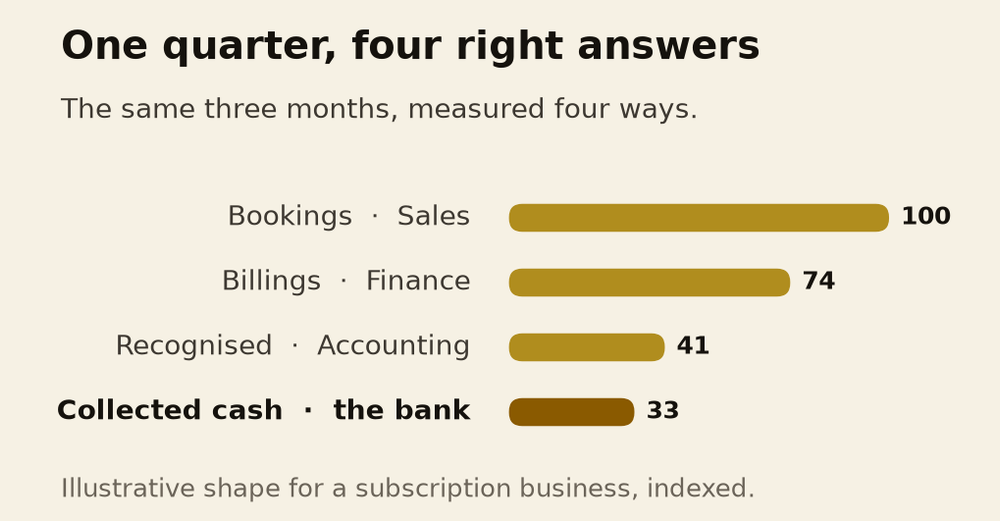
Before you decide who owns revenue, decide which revenue. I have sat in a weekly leadership meeting where the CEO was tracking bookings, the CFO was tracking collections, and the head of marketing was tracking pipeline created, and the three of them disagreed about whether the business was growing for four months.
What the research actually says about who holds it
I went looking for hard data on how companies structure this. What exists is thin, and worth knowing how thin.
Nobody can tell you who coined "RevOps". The most-repeated attribution names a software CEO in 2016 with no citation behind it, and the company's own materials describe him as an early advocate rather than the originator. The earliest institutional uses I could confirm are from 2019. For a discipline this confident, that is a strange gap.
The famous Gartner prediction is a prediction. The widely quoted line is that 75% of the highest growth companies will run a RevOps model by 2025. Gartner's current version says by 2026, up from less than 30% today. The target year moved, and the baseline has no stated source. It was never a measurement of anything.
Where RevOps reports is genuinely unsettled. One survey of operations professionals puts the reporting line at CRO 41%, CFO 21%, COO 10%. Another puts CRO 30%, CEO 26%. A dataset of 746 companies finds Operations the most common parent in most size bands, with Finance at around 20% in the 51 to 100 employee range, dropping to about 9% by 200 people. These do not reconcile, and part of the reason is that each survey defines "having RevOps" differently.
And the function is usually tiny. In one professional body's survey, 41% of RevOps teams had two to four people, 22% were a single person, and 40% had no dedicated budget at all.
So the honest picture is a young function, with no agreed home, frequently staffed by one person without a budget, expected to own the number that four executives are each measured on differently.
The numbers that actually describe the problem
Three findings from the same body of survey work say more than any definition.
- Only 34% of companies share revenue and pipeline goals between sales and marketing. In two thirds, the two teams are chasing different targets by design.
- Only 10% have a CRO sitting over marketing, sales and customer success. The single-owner structure everyone describes as best practice is rare.
- In 21%, nobody in the C-suite owns sales and marketing alignment. Not a disputed owner. No owner.
These are vendor surveys of self-selected operations people, so discount them accordingly. The direction is consistent across all of them, which is the part I would bet on.
Why this fragments, and why it is not anyone's fault
This is the part I find genuinely interesting, and it is older than SaaS.
The mechanism was described properly in 1991 by Holmström and Milgrom, in work on what happens when you measure an agent on one of several tasks. An agent measured on one dimension will shift effort away from the dimensions that are not measured, even when those dimensions matter more to the principal.
Apply it. A salesperson paid on bookings will underinvest in the things that do not book: data hygiene, qualifying out a bad-fit customer, a careful handover to delivery. Not out of laziness. Because the compensation plan told them what counts, and they listened.
Steven Kerr put the same idea more bluntly in 1975, in a paper titled "On the folly of rewarding A, while hoping for B." Half a century ago, and still the most accurate description of most compensation plans I have reviewed.
There is a related trap for forecasts specifically. When a forecast later becomes a target or a basis for quota, it stops being a prediction and becomes a negotiation. People shade it. Not dishonestly, defensively. The moment you attach consequences to a forecast, you have stopped measuring the future and started measuring your team's view of you.
And underneath all of it sits Lawrence and Lorsch's 1967 finding that specialised departments naturally develop different time horizons, goals and vocabularies, and that organisations therefore need explicit integrating roles. RevOps is that integrating role, rediscovered and renamed. It is not new thinking. It is 1967 thinking with a CRM attached.
What I actually found inside one company
The theory above is tidy. Here is the untidy version.
I inherited an account where the paid acquisition was working. Leads were coming in under four dollars each, across almost fifty thousand dollars of spend, thirteen thousand of them. Revenue was flat and everybody assumed the traffic was junk.
Then I opened the CRM.
Seventeen automations had been built. Not one had ever been switched on.
Somebody had done the work. Somebody had scoped the follow-up sequences, the stage transitions, the notifications, and built them properly. And then nobody turned them on, because turning them on was not in anybody's job description. The person who built them was measured on building them.
That is not a technology failure. That is the exact gap Holmström and Milgrom described, sitting in a CRM.
The second finding was about which number the company was steering by, and it is the cleaner illustration of this article's whole argument.
They were selling a $300 to $500 a month service. Measured on bookings, that looked like a growing customer count. Measured on collected cash, it was a business whose revenue arrived in dribs and could stop at any month's notice.
Rebuilding the offer into a $5,000 three month programme took paid in full from 43% to 90% of deals, across 376 deals and $1,117,757 collected over thirteen months.
Two honesty notes, because this is the number I would most expect someone to quote back at me. The 43% is a single trough quarter; the full series runs 61%, 43%, 66%, 85%, 90%, so the move from the starting level is about 29 points rather than 47. And the cause was the repricing, not anything clever in operations.
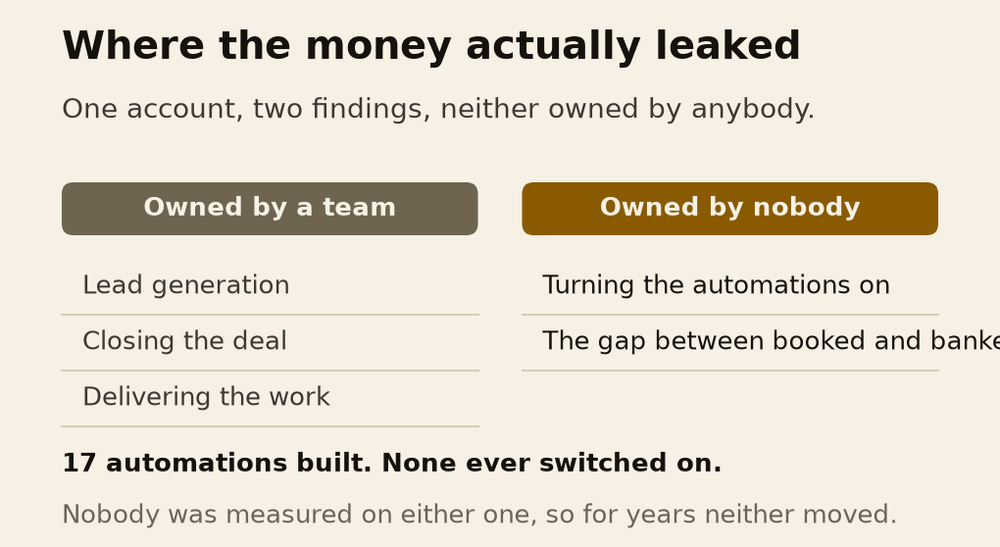
What makes it a revenue operations story is not the pricing work. It is that nobody owned the gap between what sales was measured on and what the bank actually received, so for years the two numbers drifted and the meetings stayed confusing.
About that CRM failure statistic
While we are dismantling things, this one deserves it, because it gets quoted at every RevOps budget meeting.
You have heard that most CRM implementations fail. Somewhere between 50% and 70%, depending on who is talking.
Here is where it came from. A 2001 Gartner survey of roughly 500 of its own clients, all large organisations, asked whether their CRM implementation met expectations. 55% said it did not.
Then, in the words of the Gartner analyst who later explained it publicly, people "chopped the 'meet expectations' off it and just said failure."
About 5% chose absolute failure. The majority picked something closer to "disappointing but somewhat successful", mostly about payback period. It was a prediction-shaped survey of one firm's client base, taken in 2001, and Gartner never repeated the study.
So the stat that justifies a lot of caution and a lot of consulting fees is a twenty-five year old satisfaction question with its qualifier removed.
I am not arguing CRM projects go well. I am arguing that nobody has measured it this century, and you should notice when a number that old is doing that much work.
What to actually do
- Name the number before you name the owner. Write down which of bookings, billings, recognised revenue or collected cash the leadership meeting is about. Most of these arguments end there.
- Find your gaps by looking for unowned handoffs, not unowned functions. List every point where work passes between two teams and ask who is measured on that transition. The answer is usually nobody.
- Check what has been built and never switched on. Every company I have opened has some version of my seventeen automations. It is the cheapest audit in this article.
- Do not hire RevOps to fix a compensation problem. If sales is paid on bookings and you want retained revenue, no operations hire closes that gap. Change the plan or accept the behaviour.
- At under about 50 people, do not hire for this. Give it to whoever already owns the CRM and give them explicit authority over the handoffs. The function matters long before the headcount is justified.
- Treat forecast and target as different documents. The moment they are the same document, your forecast becomes a negotiation.
The question in the title does not have a universal answer, and anyone selling you one is selling an org chart.
What it has is a local answer, and you can find it this week. Pick the gap where your money is leaking, and put one name next to it.

Ahmad Zabir
GTM expert and marketing consultant for SaaS companies, software houses and fitness brands. He diagnoses why growth stalls, designs the fix, and trains the team to run it.
One teardown a month
Research like this, before it goes public. No cadence promises I will not keep.
How Software Houses Get Clients Beyond Upwork and Referrals
When Upwork and referrals are most of your revenue. Upwork's take rate has risen from 15.4% to 19.6% while the platform shrank, and the real constraint is that your best salesperson is also your most billable engineer.
Marketing Agency or In-House: The Test That Answers It
No study compares the outcomes, so stop looking for one. The make-or-buy test that actually answers it, why clients leave agencies over budget cuts rather than performance, and when the answer is neither.
How to Judge an Outsourced SDR Team in 30 Days
You cannot see effort or quality, and revenue is two quarters away. A 30-day scorecard and written kill criteria for an outsourced SDR or lead generation trial, built on what the economics of information actually predict.
Find the Broken Layer in Your Funnel, Using Your Own CRM
Traffic looks fine, revenue is flat, and nobody can say why. How to diagnose it from your own CRM: confidence intervals on small samples, Simpson's paradox, survivorship, and where deals pile up versus vanish.
Not sure which of these you actually need?
Bring your funnel and your numbers. You leave knowing what to fix first and what to ignore.
Apply for a Consult